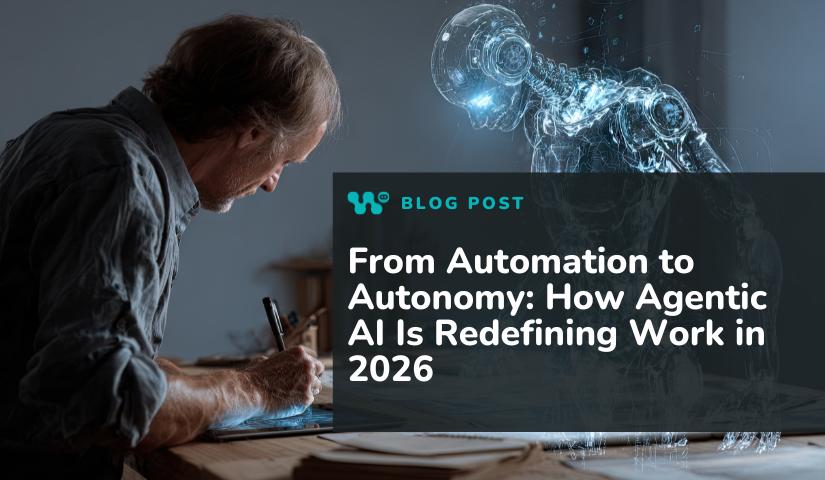
From Automation to Autonomy: How Agentic AI Is Redefining Work in 2026
From Automation to Autonomy: How Agentic AI Is Redefining Work in 2026
As we venture deeper into 2026, a remarkable shift is underway in how work is performed. Moving beyond traditional automation, the emergence of agentic AI introduces a new wave of autonomous digital workers, systems capable of independent decision-making, adaptive learning, and proactive collaboration. This revolution in enterprise technology promises to redefine business processes at an unprecedented scale and speed.
The Rise of Agentic AI: Catalyzing the Autonomous Enterprise
Agentic AI marks a shift from tools that assist humans to intelligent agents that independently plan, execute, and optimize complex workflows. According to market analysts, approximately 40% of enterprise applications are expected to embed agentic AI capabilities by the end of 2026, a rapid increase from under 5% in 2025. These agents are not just automation scripts; they are cognitive collaborators capable of real-time data analysis, anomaly detection, and autonomous problem-resolution operating with agility far beyond static automation.
This new paradigm enables businesses to delegate end-to-end processes such as customer support automation, supply chain coordination, fraud detection, and marketing campaign management to digital agents who continuously learn from each interaction and improve without direct human intervention. This shift towards autonomous systems is transforming traditional workflows into dynamic, intelligent networks of digital co-workers working alongside human teams.
Real-World Transformations: From Reactive Automation to Proactive Intelligence
Enterprises adopting agentic AI benefit from significant operational improvements. Customer service centers witness drastic reductions in response and resolution times as agentic systems intelligently manage inquiries, retrieve relevant information, and escalate only complex issues to humans. In logistics, multi-agent AI networks monitor inventories, dynamically reroute shipments, and predict risks to supply continuity, minimizing disruptions and costs.
Finance and compliance departments leverage agentic AI to continually analyze transactions, identify evolving risk patterns, and automate audit processes significantly reducing manual workload and enhancing accuracy. These agents augment human expertise rather than replace it, enabling employees to concentrate on strategic initiatives, creative problem-solving, and innovation.
Challenges and Strategic Considerations
Despite its transformative potential, agentic AI adoption introduces new challenges. Many organizations struggle to identify clear business outcomes, maintain data integrity, and deploy effective governance frameworks to avoid pitfalls such as “agent-washing” (mislabeling conventional automation as agentic AI) and accidental bias. Cultivating a culture prepared for human-agent collaboration and redesigning IT architecture to support scalable, secure, and compliant agentic AI systems are critical to successful implementation.
Technologically, agentic AI demands robust cloud infrastructure, continuous model retraining, and advanced cybersecurity mechanisms. Enterprises must prioritize transparency, explainability, and accountability to ensure these powerful digital workers align with business ethics and regulatory requirements.
Embracing the Agentic Future Today
To harness the advantages of agentic AI, businesses should start by assessing their current AI maturity, selecting high-impact workflows for pilot projects, and establishing cross-functional teams to oversee deployment and adoption. Pilot initiatives might include automated IT support, predictive maintenance, or customer journey optimization areas where agentic AI can demonstrate tangible ROI quickly.
Education and change management initiatives empower human teams to work effectively with digital agents, fostering trust and maximizing productivity gains. Early adopters stand to gain a competitive edge by leveraging agentic AI’s ability to drive continuous learning and intelligent autonomy in their operations.
Conclusion
The journey from traditional automation to agentic AI-driven autonomy represents one of the most significant shifts in enterprise technology of this decade. By transitioning towards autonomous digital workers, businesses unlock new levels of efficiency, speed, and innovation that are essential to thrive in an increasingly complex and fast-paced market. As 2026 unfolds, the companies embracing this intelligent future will lead the charge, creating resilient, adaptive organizations powered by the symbiosis of human and agentic intelligence.
Leave your comment
Intelligent Automation as a Service: 75% Infra Savings for Enterprise-Ready Automation
IaaS: 75% Infra Savings for Enterprise-Ready Automation
READ THE FULL ARTICLE
Slash 75% Infra Costs with Intelligent Automation as a Service
Slash 75% Infra Costs with Intelligent Automation
READ THE FULL ARTICLE

Pune Expo 2025: What An Incredible Three Days!
Pune Expo 2025 What An Incredible Three Days!
READ THE FULL ARTICLE


